Fall of the Berlin Wall, November 9, 1989
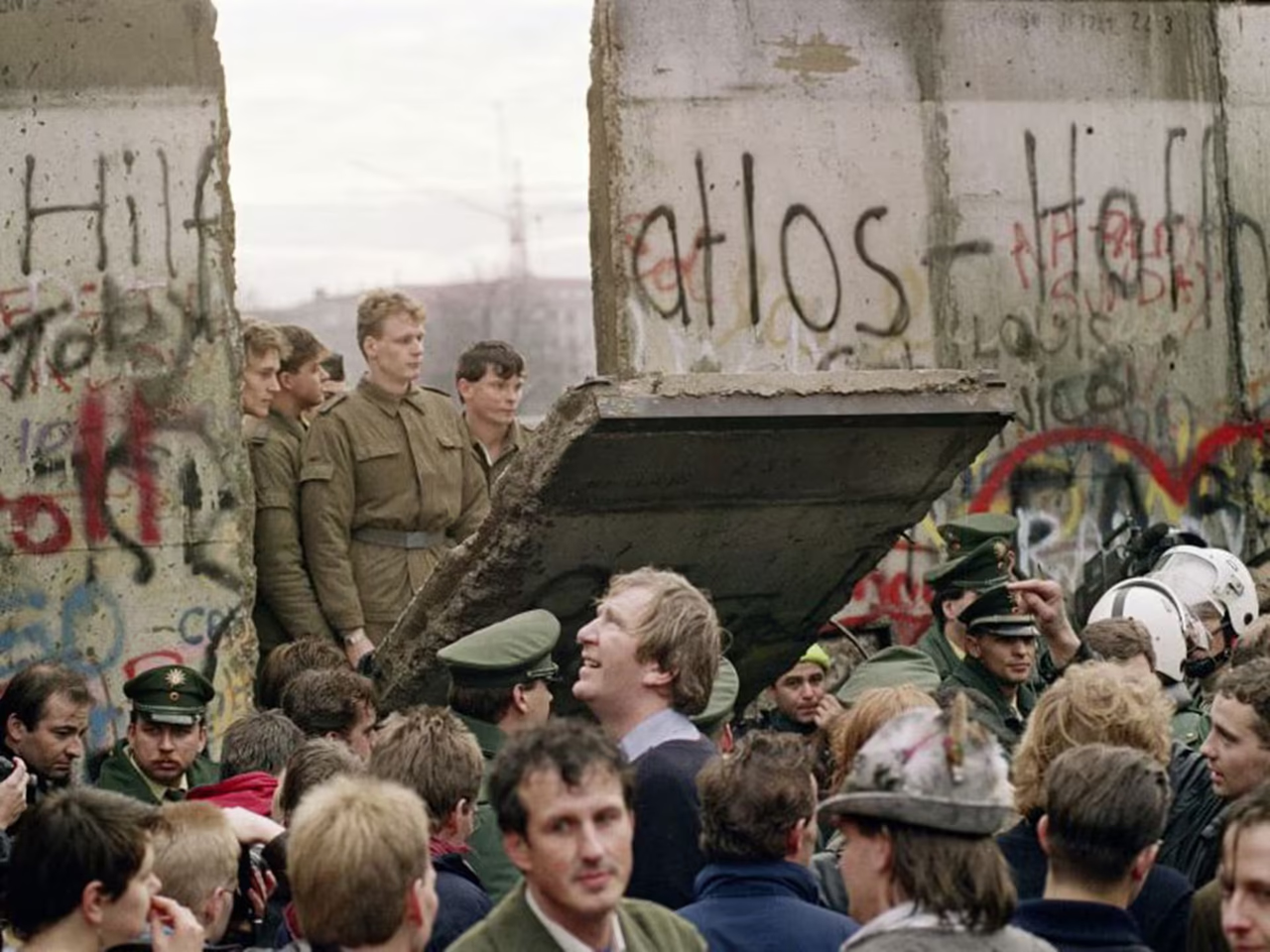
The Berlin Wall had stood for more than 28 years. Built in August 1961 by the East German government, it stretched roughly 96 miles around West Berlin. Its purpose was simple: stop East Germans from fleeing to the democratic and more prosperous West. Before the wall went up, more than 3 million people had escaped East Germany, draining the country of workers, professionals, and young people.
The wall quickly became far more than a barrier of concrete. It evolved into a heavily fortified border complete with guard towers, anti-vehicle trenches, barbed wire, floodlights, patrol roads, and the infamous “death strip.” Border guards had orders to stop escape attempts, and at least 140 people are known to have been killed trying to cross the Berlin Wall, though some estimates are higher.
By the late 1980s, however, the Soviet Union was changing. Under Mikhail Gorbachev, reforms known as glasnost and perestroika loosened political control across the Eastern Bloc. Unlike previous Soviet leaders, Gorbachev made it clear that Moscow would no longer send tanks to prop up struggling communist governments.
Across East Germany, protests grew larger each week. Citizens demanded free elections, freedom to travel, and political reform. At the same time, thousands of East Germans escaped by traveling through newly opened borders in Hungary and Czechoslovakia, placing enormous pressure on the East German government.
The dramatic breakthrough came almost by accident. During a televised press conference on November 9, Politburo spokesman Günter Schabowski announced new travel regulations. When asked when they would take effect, he glanced at his notes and mistakenly replied, “As far as I know… immediately, without delay.” Millions of East Germans watching television believed the border had opened.
Crowds immediately gathered at checkpoints throughout Berlin. The border guards had received no instructions and were completely unprepared. As the crowds continued to grow and tensions mounted, the commander at the Bornholmer Strasse crossing made the historic decision just before 11:30 p.m. to open the gates rather than risk violence.
The scenes that followed were broadcast around the world. Families separated for decades embraced one another. Strangers climbed onto the wall waving flags and drinking champagne. People danced on top of what had once been one of the most heavily guarded frontiers on Earth, while others attacked the concrete with sledgehammers, taking home pieces as souvenirs.
The fall of the Berlin Wall marked the beginning of the end for communist rule across Eastern Europe. Less than a year later, on October 3, 1990, East and West Germany were officially reunified. The Soviet Union itself would dissolve the following year, bringing the Cold War to a close after more than four decades.
Henry Ford receiving the Grand Cross of the German Eagle from Nazi officials, 30 July 1938, on his 75th birthday
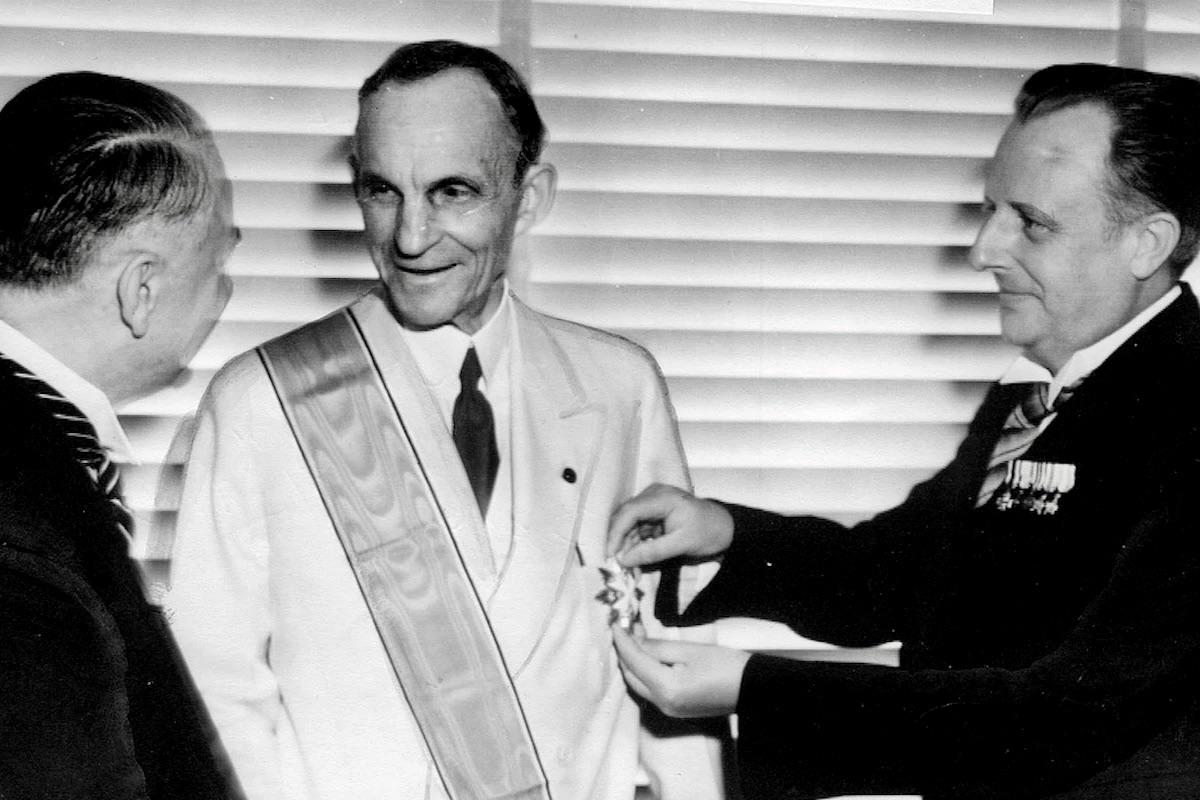
On July 30, 1938, Henry Ford marked his 75th birthday with a ceremony at his estate in Dearborn, Michigan. Among the birthday congratulations was an official delegation from Nazi Germany, which presented Ford with the Grand Cross of the German Eagle, the highest decoration the Third Reich could bestow upon a foreign civilian.
The medal was presented by Karl Kapp, the German consul in Cleveland, along with Fritz Heller, the German consul in Detroit. Adolf Hitler also sent Ford a personal birthday message. Photographs from the event show Ford standing beside the German diplomats as they presented him with the ornate medal.
Officially, the award recognized Ford’s influence on modern manufacturing. His moving assembly line had transformed industrial production and made automobiles affordable to millions. German manufacturers had studied Ford’s production methods for years, and his factories influenced industrial planning throughout Europe.
Ford’s reputation in Germany, however, extended beyond engineering. During the early 1920s, he owned The Dearborn Independent, a newspaper that published a long series of antisemitic articles.
Those articles were later collected into four volumes titled The International Jew. The books were translated into several languages and circulated internationally, including in Germany.
Adolf Hitler admired Ford long before taking power. In Mein Kampf, published in 1925, Ford was the only American mentioned by name. Nazi publications frequently praised him, and Hitler reportedly kept a portrait of Ford in his office.
By the time Ford received the medal in 1938, Germany had already undergone a dramatic transformation. Hitler had become dictator, political opposition had been crushed, and the Nuremberg Laws had stripped German Jews of their citizenship.
Ford had attempted to distance himself from The Dearborn Independent years earlier. In 1927, following a highly publicized libel lawsuit, he issued a public apology and the newspaper stopped publishing.
After the United States entered World War II, Ford Motor Company became one of America’s largest wartime manufacturers. Its factories produced B-24 bombers, military trucks, tanks, engines, and other equipment used by the Allied forces.
After the war, researchers uncovered evidence that Ford’s German subsidiary, Ford-Werke, had relied heavily on forced labor. Historical records also linked its wartime operations to prisoners from Auschwitz and other victims of the Nazi labor system.
Soviet Marshal Georgy Konstantinovich Zhukov, 1960.
This 1960 portrait shows Soviet Marshal Georgy Konstantinovich Zhukov wearing an astonishing collection of military decorations. By the end of his career, Zhukov had become the most decorated senior commander in Soviet history and one of the most successful generals of the Second World War.
Born in 1896 to a poor peasant family west of Moscow, Zhukov began his military career in the Imperial Russian Army during World War I. After the Russian Revolution, he joined the Red Army and steadily rose through the ranks during the Soviet Civil War and the turbulent years that followed.
Zhukov first gained international attention in 1939 when he defeated the Japanese Army at the Battle of Khalkhin Gol on the border of Mongolia and Manchuria. His decisive use of tanks, artillery, and encirclement tactics inflicted a crushing defeat on Japan and convinced Tokyo to focus its future expansion southward rather than against the Soviet Union.
When Nazi Germany invaded the Soviet Union in June 1941, Zhukov quickly became Joseph Stalin’s most trusted battlefield commander. He played a critical role in organizing the defense of Moscow, helping halt the German advance just miles from the Soviet capital during the winter of 1941.
Over the next four years, Zhukov was involved in nearly every major Soviet victory. He helped coordinate Operation Uranus, which trapped Germany’s Sixth Army at Stalingrad, oversaw the Soviet defense during the Battle of Kursk, directed Operation Bagration, which destroyed Germany’s Army Group Centre, and ultimately commanded the 1st Belorussian Front during the final assault on Berlin in 1945.
On May 8, 1945, it was Zhukov who accepted Germany’s unconditional surrender on behalf of the Soviet Union. A month later, he rode a white horse through Moscow’s Red Square while reviewing the Soviet Victory Parade, cementing his place as one of the faces of the Allied victory in Europe.
The medals covering Zhukov’s uniform reflect that extraordinary military career. Among them are four awards of the title Hero of the Soviet Union, the country’s highest honor for personal heroism, along with multiple Orders of Lenin, Orders of Suvorov, and decorations from allied communist nations. He also received numerous foreign awards from countries including Poland, Czechoslovakia, France, Yugoslavia, and Mongolia.
Despite his popularity, Zhukov’s relationship with Stalin was uneasy. Stalin reportedly viewed the celebrated marshal as a potential political rival and removed him from prominent command positions after the war. Following Stalin’s death in 1953, Zhukov briefly returned to power, eventually serving as the Soviet Union’s Minister of Defense.
His political comeback was short-lived. In 1957, Soviet leader Nikita Khrushchev dismissed Zhukov, fearing that the marshal’s prestige within the military had become too great. Zhukov spent the remainder of his life largely out of politics, writing his memoirs and occasionally appearing at public events.
Hatfield family of the Hatfield-McCoy feud (that grew out of the civil war) on porch of cabin in Welch, W. Va., 1899

By the time the picture was taken, the Hatfield-McCoy feud had become one of the most famous family conflicts in American history, inspiring newspaper headlines, dime novels, and eventually becoming part of American folklore.
The roots of the feud stretched back to the Civil War. The Hatfields lived primarily in what became West Virginia, while the McCoys lived just across the Tug Fork River in Kentucky. Although the families were neighbors, the war placed them on opposite sides. Most of the Hatfields supported the Confederacy, while Randolph “Ole Ran’l” McCoy remained loyal to the Union. The bitterness left behind by the war lingered long after the fighting ended.
Tensions first erupted in the years after the war over disputes involving land, timber, and livestock. One of the earliest flashpoints came in 1878, when Randolph McCoy accused Floyd Hatfield of stealing one of his hogs. The case went to court, where a jury ruled in favor of the Hatfields. The verdict only deepened the distrust between the two families.
The conflict turned deadly in the early 1880s. A romance between Roseanna McCoy and Johnse Hatfield briefly offered hope that the families might reconcile, but the relationship collapsed, and hostilities continued. In 1882, three McCoy brothers murdered Ellison Hatfield after an election-day argument. The Hatfields captured the brothers before authorities could intervene and executed all three in retaliation.
Violence escalated over the next several years. On New Year’s Night in 1888, a group of Hatfields attacked Randolph McCoy’s cabin. The house was set on fire, two of McCoy’s children were killed, and his wife was badly beaten. Randolph himself escaped into the woods with surviving family members.
The attack drew national attention. Kentucky authorities pursued the Hatfields into West Virginia, while bounty hunters and posses became involved. The dispute eventually reached the U.S. Supreme Court after Kentucky arrested several Hatfields across state lines, creating a legal battle over extradition between the two states.
The violence finally began to subside in 1889. Several Hatfields were convicted for their roles in the attacks, and Ellison “Cottontop” Mounts, a Hatfield relative, was executed by hanging in 1890. Public opinion increasingly turned against the feud, and both families gradually abandoned the cycle of revenge.
By the time this photograph was taken in 1899, nearly two decades had passed since the bloodiest fighting. While old resentments remained, the feud itself had largely ended. The Hatfields had returned to farming, logging, and raising families in the rugged Appalachian mountains.
The Hatfield-McCoy feud claimed the lives of roughly a dozen people, far fewer than many people imagine today. Yet sensational newspaper coverage transformed the story into a national obsession. It became a symbol of frontier justice, family loyalty, and the lawlessness often associated with Appalachia, even though most residents of the region had no connection to the violence.
Jack Ruby Shoots Lee Harvey Oswald, November 24, 1963

This photograph captures one of the most shocking moments in American history. On November 24, 1963, just two days after President John F. Kennedy was assassinated in Dallas, nightclub owner Jack Ruby stepped out of a crowd inside the basement of Dallas Police Headquarters and shot the president’s accused killer, Lee Harvey Oswald, at point-blank range. The shooting was broadcast live on national television, stunning millions of viewers.
Following Kennedy’s assassination on November 22, Oswald had been arrested and charged with murdering both the president and Dallas police officer J.D. Tippit. The nation was desperate for answers, and authorities planned to transfer Oswald from police headquarters to the county jail, where security was expected to be tighter.
Television cameras crowded into the police garage to film the transfer. Reporters, photographers, and police officers lined the basement as Oswald, handcuffed and flanked by detectives, emerged wearing a dark sweater. At 11:21 a.m., as officers escorted him toward an armored vehicle, Jack Ruby suddenly lunged forward from the crowd.
Ruby fired a single .38-caliber revolver round into Oswald’s abdomen. The impact sent Oswald collapsing to the floor while detectives wrestled Ruby to the ground. The entire sequence lasted only a few seconds, but because it happened during a live television broadcast, it became one of the first violent events witnessed simultaneously by millions of Americans.
Oswald was rushed by ambulance to nearby Parkland Memorial Hospital—the same hospital where doctors had unsuccessfully tried to save President Kennedy just 48 hours earlier. Surgeons operated for more than an hour, but Oswald died that afternoon at the age of 24.
Jack Ruby, born Jacob Rubenstein, owned several nightclubs in Dallas and was well known to many local police officers. During questioning, Ruby claimed he acted out of grief over Kennedy’s assassination and wanted to spare Jacqueline Kennedy the ordeal of returning to Dallas for Oswald’s trial. Investigators found no credible evidence that Ruby had been part of a larger conspiracy, although his motives have remained the subject of debate for decades.
In March 1964, Ruby was convicted of murdering Oswald and sentenced to death. However, the Texas Court of Criminal Appeals overturned the conviction in 1966 because of errors during the trial and ruled that he deserved a new one. Before that retrial could begin, Ruby was diagnosed with lung cancer and died in prison on January 3, 1967.
Oswald’s death meant the only man officially charged with assassinating President Kennedy never stood trial. As a result, the public never heard evidence presented in open court or saw Oswald questioned extensively under oath. That vacuum helped fuel decades of speculation and conspiracy theories surrounding the assassination.
The Warren Commission, established by President Lyndon B. Johnson in 1963, concluded that Lee Harvey Oswald acted alone in assassinating President Kennedy and that Jack Ruby also acted alone in killing Oswald. While those findings remain the official conclusion of the U.S. government, the events of November 22–24, 1963, continue to be among the most scrutinized in American history.